A poem by Mongolian scholar-poet Zava Damdin (b. 1976). Please refer to the Index of Mongolian Poetry and Articles for other works that may be of interest.
_____________________________
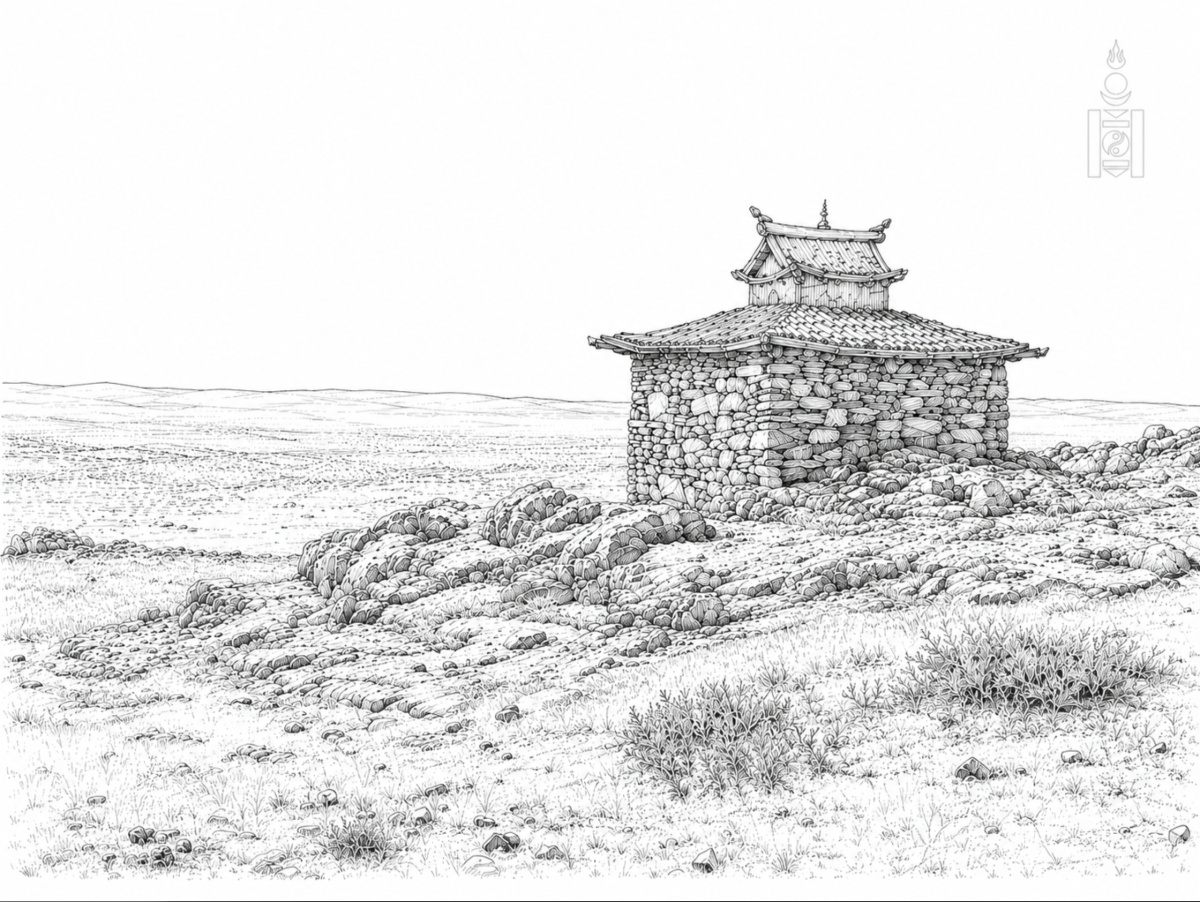
Plate note: A digital pen-and-ink rendering from a photograph of the restored winter retreat hut of Zava Damdin (1867–1937), the prominent Khalkha Mongolian Buddhist abbot, polymath, historian, and philosopher. The stone hut was repaired by Zava Damdin Rinpoche (b. 1976) and his family in 2004. It still stands at Delgeriin Choira, Delgertsogt Sum, in Mongolia’s Gobi Desert. The view looks south, with east to the left and west to the right. Delgertsogt Mountain extends behind the hut along its lower slopes. Photograph taken on 8 April 2011. CP archive. Digital art and original photograph: C. Pleteshner for CPinMongolia.com. 16 July 2026.
_____________________________
PLAYING NAADAM
(English translation)
Learn to sit alone, at some distance.
Having mirrored your heart, behold the world around you.1Mirroring (тольдох): The Mongolian verb тольдох may be rendered as to mirror, to reflect upon, or to behold. In the opening couplet, it appears twice: Гагц сэтгэлээ тольдон эгэлхэн орчлыг тольд. The repetition directs the same act of attentive seeing first towards one’s own heart, then towards the surrounding world. The English preserves this echo where possible.
Listen closely, for the morning birdsong is the most joyful of all.
In those tiny, endearing birds there are surely the soloists of an orchestra.
Feel, with your whole body, the gentle caress of the late-morning breeze.
Its form unseen, it seems to come from another realm, soothing you with its touch.
Dance together like children when a sun shower falls at noon, palms outstretched to receive it.
Perhaps some wonder has broken free from a story.2Story (үлгэр): The Mongolian үлгэр may be rendered as story, tale, legend, or fable, depending on context. Here, story was chosen because it preserves the sense of something marvellous emerging from narrative while also leaving open the possibility of the inner stories through which people experience and make sense of the world.
Know the rainbow’s seven embroidered bands, whether near or far, as art without artifice.
For whoever is young at heart, receive it as a gift, imagining it as a young woman’s dress.3Seven embroidered bands (солонгын долоон шаглаа): The phrase compares the rainbow’s seven colours to lines of stitched or patterned ornament. Here, шаглаа gives the rainbow a textile quality: its colours appear not simply as bands of light, but as finely worked, expressive decoration. This image continues into the following line, where the rainbow is imagined as a young woman’s dress, linking colour, stitching, clothing, and symbolic ornament within a single visual field. It should not, however, be taken as evidence of a separate Mongolian system for classifying the rainbow.
Pause beneath the midday sky and behold the scattered lamb-clouds gathered there;
they transform into white lions of legend, beautiful galbingaa birds,4Galbingaa bird (галбингаа): The Mongolian галбингаа names the Buddhist kalaviṅka, a marvellous bird renowned for the beauty of its voice and associated with celestial music. Here, it appears among the forms into which the small clouds seem to transform. In a Mongolian pastoral reading, inherited Buddhist imagery enters the attentive observation of sky, weather, distance, and movement without displacing the directly observed landscape. Comparative scholarship supports the close relation between marvellous Buddhist bird figures and music, while Mongolian ethnography emphasises landscape as a field of situated movement and relational attention rather than passive scenery (cf. Rambelli 2021; Humphrey 1995; Humphrey and Sneath 1999).üzeng falcons,5Üzeng falcon (үйзэн шонхор): For now, the precise identification and literary history of үйзэн шонхор remain unresolved. Шонхор clearly denotes a falcon, whose speed, acuity, height, and command of open space carry strong resonance within Mongolian pastoral life and imagery. Here, however, the falcon first appears as a cloud-form, perceived through sustained attention to the midday sky. This allows it to be read through Mongolian familiarity with birds of prey and the open steppe without assuming that the phrase denotes a particular species or fixed symbolic figure. Until үйзэн can be securely established through Mongolian lexicographical or textual evidence, üzeng falcon is retained as a deliberately provisional rendering. and their companions.
Go and sit in the shade when the high noon sun burns down upon the crown of your head.
Though heavy with drowsiness, your heart settles deeply, and serenity breathes through the world.6Breathes through (тэтгэмүй): The Mongolian тэтгэх carries a broad range of meanings, including to sustain, to support, and to nourish. Rather than assigning a single English equivalent to the verb, breathes through was chosen because it more closely reflects the translator’s understanding of Rinpoche’s intended meaning in this context.
As the sun eases over the mountain ridge, walk slowly along the mountain’s hem.
The lives and deeds of the noble elders come to mind, and from them a certain courage and inspiration arise.
Lady Moon rises, her smile now visible, as though calling, “You…”
At that same moment, the shepherd boy opens his lyrical heart in song.
Beneath the spreading milky white light, watch where Old Raven flies.
It bears some knotted message7Knotted message (мэдээ занги): The expression мэдээ занги is difficult to render with a single English equivalent. Занги literally denotes a knot or something tied together. Rather than resolving the phrase into a more familiar English idiom, knotted message preserves both its physical image and its openness. This translation reflects the translator’s understanding that the line gestures towards news, signs, or meanings that remain gathered rather than immediately revealed.from this unfolding, intertwined world.
As dusk falls, the wind grows still; in the absence of even the smallest sound, listen.
Among all living beings, it is the cow, having reached the encampment, lowing, who calls all beings to rest.
As the horseman, remaining awake, sits watching and reading his tethered horses,
the stars gather in clusters, and the Milky Way stretches like the dust of ten thousand galloping horses.
When fox-darkness8Fox-darkness (үнэгэн харанхуй): The compound үнэгэн харанхуй literally joins fox and darkness. I could not find a definitive lexicographical or scholarly explanation of the expression. Studies of Mongolian colour terminology show the language’s capacity for highly specific visual and descriptive compounds, but neither source discusses үнэгэн харанхуй directly (cf. McCarthy et al. 2019; Purev et al. 2023). Fox-darkness is therefore retained closely, preserving its animal, visual, and atmospheric associations without assigning it a fixed meaning.covers everything, it becomes as though the Great Khan’s decree has descended.
Then old and wise alike dwell in stillness, and the world appears as though empty.
As dawn brightens from the east, learn, as the wise do, to wake and stretch.
Your innermost heart will stir with goodwill towards every living creature.
As Brother Sun blazes and gives out his countless orange rays, holding nothing back,
we should direct our efforts towards the flourishing of the place that has sustained us throughout our lives.
Behold the beginning of Naadam in the remarkable place called Mongolia.
Let your mind race to discern the source of an unfaltering courage.
When the turf of the Naadam ground has ripened, green, level, and full,
the many, modest yet proud, don their zodog9Zodog (зодог): The zodog is the close-fitting, open-chested upper garment worn by Mongolian wrestlers during Naadam.and shuudag10Shuudag (шуудаг): The shuudag is the short, tightly fitted wrestling brief worn with the zodog during Naadam.and follow in the footsteps of the elders.
Look upon the myriad horses, brought to perfect readiness, raising the dust of heaven from the earth.
Did the heart-stirring giingoo11Giingoo (гийнгоо): The giingoo is the long, sustained call sung by child riders during Mongolian horse races. It encourages the horses and carries across the steppe as one of Naadam’s most recognisable sounds.resound from the child rider’s chest, or from the horse’s throat?
Does each release of the strung bow rest under the master archer’s thumb and finger, or under the bow and arrow?
Or does it rest under the paired wings of method and wisdom, before which the whole vast world once bowed?
Learn to sit alone, at some distance.
Having mirrored your own heart, behold the world around you.
When the Great Naadam takes place, learn to sit alone.
Learn the wisdom of seeing all its lively contests as one.
Since one cannot yet fathom what lies beyond ordinary knowing,
Courageously, direct your thoughts12Thoughts (бодрол): The Mongolian бодрол may be rendered as thoughts, reflections, contemplations, or considered thoughts, depending on context. Thoughts was chosen here for its simplicity and breadth, without giving the line an overly philosophical or Buddhist register.and uncommon gifts13Uncommon gifts (эгэл үгүй өгөгдөл): The expression өгөгдөл is difficult to render with a single English equivalent. Depending on context, it may be understood as givenness, endowment, gift, capacity, talent, ability, potential, calling, inheritance, or what has been given. Uncommon gifts was chosen because it preserves the breadth of these overlapping possibilities without narrowing the expression to a single interpretation.towards one purpose.14Literary note: Throughout Playing Naadam, the poem proceeds by acts of attentive observation. The surrounding world is encountered not merely as landscape but as something to be read. This recurring pattern informed several translation choices. 15Translated by C.Pleteshner. English interpretation 16.07.2026 from the original Mongolian 10.07.2026. Translation is always an interpretation into another language and culture. Any errors in this regard are entirely my own, and for these I humbly apologise.
The Poet-boy of Tsogt Mountain
10.07.2026
Delgertsogt Mountain
_____________________________
НААДАМЛАХУЙ
(Original Mongolian)
Ганцаар алсхан сууж сур
Гагц сэтгэлээ тольдон эгэлхэн орчлыг тольд
Өглөөний шувуудын жиргээ хамгийн баясгалантай буйг сонорд
Өрөвлөг өчүүхэн шувуухайд ану найрал хөгжмийн гоцлоочид ажгуу
Бага үдийн салхин зөөлөн илбэхүйг өвч биеэрээ мэдэр
Бараа ану үл үзэгдэх орчлоос ирж буй аргадах мэт илбэл аму
Үд дор нартай хур буухуйг бүгдээр хүүхэд мэт бүжин алгаа тосон ав
Үлгэрээс хагацсан ямар нэгэн гайхамшиг болох ану магад буюу
Ойр буюу хол буюу солонгын долоон шаглаа урлал үгүй урлал хэмээхүйг мэд
Орь зүрхтэн хэн боловч залуу хатагтайн даашинз мэт сэтгэн бэлэг болгон ав
Үд дунд огторгуй дор хурсан хэсэг бусаг хурган үүлсийг саатан тольдвоос л
Үлгэрийн цагаан арслан, үзэмжит галбингаа, үйзэн шонхор сэлт лүгээ хувилмуй
Их үдийн наран зулайг чину төөнөх үе дор сүүдэр бараалан суу
Ихэд нозоорох авч сэтгэл үлэмж тогтон амарлингуйг орчлыг тэтгэмүй
Нар уулын хяр лугаа хэвийхүй дор уулын хормой шууж аажим алх
Намтар дээдсийн явдал санагдаж тийн мэт урам зориг төрөх амуй
Саран авхай мүшиеэл тодруулан чамайг хэмээсээр ургамуй
Сац шүлэг тэрлэж хоньчин хөвгүүн яруусал сэтгэлээ нээмүй
Сүүн гэгээ татахуй дор бараан хон ахай хааш нисэхүйг ажигла
Сүлэлдсэн энэ дэлхийн ямар нэгэн мэдээ занги дохиолмуй
Харуй бүрий болохуй лүгээ салхин намжиж чив чимээ үгүй дор анирд
Хамаг амьтас дундаас хотондоо хүрсэн үхэр мөөрч амрахуйг уриалах ану тэр
Адуучин бээр үл нойрсож уясан морьдоо ажин шинжин суухуй дор
Анивчих одод түгж, сүүн зам түмэн адууны тоос мэт зурхайлан үзэгдмүй
Үнэгэн харанхуй нөмөрөхүй дор их хааны зарлиг буусан мэт болоод
Үтэл, сэцэн хэн бээр ч нам жим оршин аху лугаа хоосон орчил мэт болмуй
Дорноос үүр хаяаран гийхүй дор ухаан билигтэн сэрж суниахуйг суралц
Дотно сэтгэл тань мал адгуус хэн бүр лүгээ сайн хотол өдүүлбэр төрөх болмуй
Наран ахай тоолш үгүй улбар шар сацрагаа гам үгүй шатаан түгээхүй лүгээ
Насад тэтгэсэн эх нутаг, эх орноо өөд дэвжүүлэхүй дор бүтээлийг зорих хэрэгтэй
Монгол хэмээх ер бусын нэрийтгэлт орны наадам эхлэхүйг тольд
Мохош үгүй зориг зүрх хаанаас эхлэлтэйг ухаанаа уралдуулан ухагтун
Наадмын дэвжээ зүлэг ногоорон тэгш дүүрэн боловсрохуй дор
Нармай олон даруухан омогтон зодог шуудгаа агсаж өвгөдийн мөрөөр зорчмуй
Уяа сойлго таарсан тэнгэрийн тоосыг газраас хөдөлгөгч буман морьдыг үз
Уярам гийнгоо хүүхдийн цээжнээс хадав буюу, адууны хоолойноос хадав буюу
Хөвч нумын талбил бүр эрхий мэргэний хуруун дор буюу нум сум дор буюу
Хөвчин их дэлхийг сөхрүүлсэн арга билгийн хос жигүүр дор буй буюу
Ганцаар алсхан сууж сур
Гагц сэтгэлээ тольдон эгэлхэн орчлыг тольд
Их наадам болохуй дор гагцаар сууж сур
Идэвхий бүх наадмыг нэг дор тольдохуйн ухааныг суралц
Эс бөгөөс чинадын чинадыг хэн бээр ч ухаж үл чадах тул
Эгэл үгүй өгөгдөл, бодролоо нэгэн зүг лүгээ зоригтой ёо хандуул
Цогт Уулын шүлэгч хөвгүүн
10.07.2026
Дэлгэрцогт Уул
_____________________________
ATTUNEMENT TO LANDSCAPE
In this poem, we find the idea of Naadam expanded by Zava Damdin Rinpoche beyond wholesome competition to include a harmonisation with elements of the vast Mongolian steppe. The poem draws attention to the subtler forms of attunement that become available when we take the opportunity, and the time, to notice them.
This widening of Naadam also shifts the terms of attention: the steppe is no longer a backdrop to celebration, but part of the cultural and perceptual field through which celebration itself becomes meaningful.
Drawing on a longstanding Mongolian way of relating to place, still resonant today, landscape is not primarily approached as scenery set apart for aesthetic contemplation. It is inhabited, traversed, and engaged as an active field of relations, with places and non-human presences understood to possess agencies of their own (cf. Caroline Humphrey 1995).
This way of relating to landscape provides a useful bridge into my own reading of Playing Naadam. Throughout the poem, the reader is not simply being asked to recognise the beauty of the landscape. Rather, the poem encourages us, step by step, to inhabit it attentively, until its beauty and relationships gradually disclose themselves. The aesthetic experience, whether recalled or imagined, is therefore participatory rather than detached: an appreciation shaped by sustained attention.
“Happy Naadam!” (Сайхан наадаарай!)
_____________________________
NOTES
- 1Mirroring (тольдох): The Mongolian verb тольдох may be rendered as to mirror, to reflect upon, or to behold. In the opening couplet, it appears twice: Гагц сэтгэлээ тольдон эгэлхэн орчлыг тольд. The repetition directs the same act of attentive seeing first towards one’s own heart, then towards the surrounding world. The English preserves this echo where possible. ↩︎
- 2Story (үлгэр): The Mongolian үлгэр may be rendered as story, tale, legend, or fable, depending on context. Here, story was chosen because it preserves the sense of something marvellous emerging from narrative while also leaving open the possibility of the inner stories through which people experience and make sense of the world. ↩︎
- 3Seven embroidered bands (солонгын долоон шаглаа): The phrase compares the rainbow’s seven colours to lines of stitched or patterned ornament. Here, шаглаа gives the rainbow a textile quality: its colours appear not simply as bands of light, but as finely worked, expressive decoration. This image continues into the following line, where the rainbow is imagined as a young woman’s dress, linking colour, stitching, clothing, and symbolic ornament within a single visual field. It should not, however, be taken as evidence of a separate Mongolian system for classifying the rainbow. ↩︎
- 4Galbingaa bird (галбингаа): The Mongolian галбингаа names the Buddhist kalaviṅka, a marvellous bird renowned for the beauty of its voice and associated with celestial music. Here, it appears among the forms into which the small clouds seem to transform. In a Mongolian pastoral reading, inherited Buddhist imagery enters the attentive observation of sky, weather, distance, and movement without displacing the directly observed landscape. Comparative scholarship supports the close relation between marvellous Buddhist bird figures and music, while Mongolian ethnography emphasises landscape as a field of situated movement and relational attention rather than passive scenery (cf. Rambelli 2021; Humphrey 1995; Humphrey and Sneath 1999). ↩︎
- 5Üzeng falcon (үйзэн шонхор): For now, the precise identification and literary history of үйзэн шонхор remain unresolved. Шонхор clearly denotes a falcon, whose speed, acuity, height, and command of open space carry strong resonance within Mongolian pastoral life and imagery. Here, however, the falcon first appears as a cloud-form, perceived through sustained attention to the midday sky. This allows it to be read through Mongolian familiarity with birds of prey and the open steppe without assuming that the phrase denotes a particular species or fixed symbolic figure. Until үйзэн can be securely established through Mongolian lexicographical or textual evidence, üzeng falcon is retained as a deliberately provisional rendering. ↩︎
- 6Breathes through (тэтгэмүй): The Mongolian тэтгэх carries a broad range of meanings, including to sustain, to support, and to nourish. Rather than assigning a single English equivalent to the verb, breathes through was chosen because it more closely reflects the translator’s understanding of Rinpoche’s intended meaning in this context. ↩︎
- 7Knotted message (мэдээ занги): The expression мэдээ занги is difficult to render with a single English equivalent. Занги literally denotes a knot or something tied together. Rather than resolving the phrase into a more familiar English idiom, knotted message preserves both its physical image and its openness. This translation reflects the translator’s understanding that the line gestures towards news, signs, or meanings that remain gathered rather than immediately revealed. ↩︎
- 8Fox-darkness (үнэгэн харанхуй): The compound үнэгэн харанхуй literally joins fox and darkness. I could not find a definitive lexicographical or scholarly explanation of the expression. Studies of Mongolian colour terminology show the language’s capacity for highly specific visual and descriptive compounds, but neither source discusses үнэгэн харанхуй directly (cf. McCarthy et al. 2019; Purev et al. 2023). Fox-darkness is therefore retained closely, preserving its animal, visual, and atmospheric associations without assigning it a fixed meaning. ↩︎
- 9Zodog (зодог): The zodog is the close-fitting, open-chested upper garment worn by Mongolian wrestlers during Naadam. ↩︎
- 10Shuudag (шуудаг): The shuudag is the short, tightly fitted wrestling brief worn with the zodog during Naadam. ↩︎
- 11Giingoo (гийнгоо): The giingoo is the long, sustained call sung by child riders during Mongolian horse races. It encourages the horses and carries across the steppe as one of Naadam’s most recognisable sounds. ↩︎
- 12Thoughts (бодрол): The Mongolian бодрол may be rendered as thoughts, reflections, contemplations, or considered thoughts, depending on context. Thoughts was chosen here for its simplicity and breadth, without giving the line an overly philosophical or Buddhist register. ↩︎
- 13Uncommon gifts (эгэл үгүй өгөгдөл): The expression өгөгдөл is difficult to render with a single English equivalent. Depending on context, it may be understood as givenness, endowment, gift, capacity, talent, ability, potential, calling, inheritance, or what has been given. Uncommon gifts was chosen because it preserves the breadth of these overlapping possibilities without narrowing the expression to a single interpretation. ↩︎
- 14Literary note: Throughout Playing Naadam, the poem proceeds by acts of attentive observation. The surrounding world is encountered not merely as landscape but as something to be read. This recurring pattern informed several translation choices. ↩︎
- 15Translated by C.Pleteshner. English interpretation 16.07.2026 from the original Mongolian 10.07.2026. Translation is always an interpretation into another language and culture. Any errors in this regard are entirely my own, and for these I humbly apologise. ↩︎
_____________________________
FURTHER READING
For an ethnographic view of Naadam beyond athletic competition, see Out and About 18: Naadam Beyond Sport.
For Naadam as experienced on the open steppe, see Out and About 19: Khi Doloon Khudag: Naadam on the Open Steppe.
_____________________________
REFERENCES
Humphrey, Caroline. “Chiefly and Shamanist Landscapes in Mongolia.” In The Anthropology of Landscape: Perspectives on Place and Space, edited by Eric Hirsch and Michael O’Hanlon. Oxford: Clarendon Press, 1995.
Humphrey, Caroline, and David Sneath. The End of Nomadism? Society, the State, and the Environment in Inner Asia. Durham, NC: Duke University Press, 1999.
Mend-Ooyo, Gombojav, ed. The Best of Mongolian Poetry. Translated by Simon Wickham-Smith and Sh. Tsog. Ulaanbaatar, 2007.
Ravjaa, Danzan. Perfect Qualities: The Collected Poems of the Fifth Noyon Khutagt Danzanravjaa, 1803–1856. Translated by Simon Wickham-Smith. Ulaanbaatar: Öngöt Khėvlėl, 2006.
Schafer, Edward H. The Golden Peaches of Samarkand: A Study of T‘ang Exotics. Berkeley: University of California Press, 1963.
Wickham-Smith, Simon. The End of the Dark Era. Translated from the Mongolian writings of Oidovyn Tseveendorj. Los Angeles: Phoneme Media, 2016.
Wickham-Smith, Simon. “Tradition and Modernity in the Poetry of Mongolia.” In The Best of Mongolian Poetry, edited by Gombojav Mend-Ooyo. Ulaanbaatar, 2007.
Wickham-Smith, Simon. “The Literary Presentation of the Mongolian Landscape in G. Mend-Ooyo’s Altan Ovoo.” PhD diss., University of Washington, 2013.
McCarthy, Arya D., Winston Wu, Aaron Mueller, Bill Watson, and David Yarowsky. “Modeling Color Terminology Across Thousands of Languages.” Proceedings of the 2019 Conference on Empirical Methods in Natural Language Processing, 2019.
Purev, Enkhjargal, Oyunsuren Tsend, Purevsuren Bazarjav, and Temuulen Khishigsuren. “Color Terms in Mongolian Place Names: A Typological Perspective.” Voprosy Onomastiki 20, no. 2 (2023).
Note on cataloguing: Mongolian publications frequently appear across catalogues with variations in romanisation, imprint details, publication dates, and publisher names. The entries here follow the editions consulted, while recognising that alternative catalogue records may differ.
End of transcript.
Please refer to the INDEX for other poems and articles that may be of interest.
 |
© 2013-2026. CP in Mongolia. “Mongolian Poetry 59: Playing Naadam” is licensed under the Creative Commons Attribution 4.0 International License. Open access should not be understood as the absence of attribution. Documents linked from this page may be subject to other restrictions. Posted: 16 July 2026. Last updated: 14 September 2026. |